
Craig Aitchison
Panoramic photography of the Scottish Highlands and Islands
Panoramic photography of the Scottish Highlands and Islands
I’ve no formal training. I came to photography late, taught myself, and learned almost everything by getting it wrong first. Twenty years on, I’m still learning. The first fourteen of those years were spent shooting film with three fixed lenses, and paying processing and scanning bills that would make your eyes water. It was an expensive education, but probably the best one I could have had. I shoot digitally now, but the discipline film taught me has never left, and the way I work has never really changed.
I’m impatient, and I like to be in control. Both are a problem, because landscape photography is little more than waiting, and you control almost none of it. You can choose where you go, and when. Everything else, the clouds, the snow, the light, whatever it is that transforms an ordinary scene into something unforgettable, is out of your hands. You must go out with hope more than expectation because every trip is a gamble, and most of them don’t pay off. Honestly, it’s a wonder I come home with anything at all.
The fact of the matter is, every photograph I’ve been pleased with came down to being in the right place when the light did something I could never have planned. There’s a notion that there’s no such thing as luck in landscape photography. That’s nonsense. It’s nearly all luck, because you can’t make it happen. You can only be there and hope it does.
So, that’s about the size of it. I’m stubborn, so I go back. If the light doesn’t show, then I climb the hill again; it’s as simple as that. There are no shortcuts in mountain photography. Not in Scotland.
It’s a wonder I come home with anything at all.

Land and Light exists to show Scotland as I found it. I put everything into making these photographs, so it matters to me that what you see is real. Nothing added. Nothing faked. One honest frame, exactly as it happened. What you see is what I saw.
Most of my photographs are planned long before they’re taken. It starts with the most efficient route in, the shortest route out, the weather, the tides, the season, and the narrow window when the conditions might come good. I enjoy that part as much as the climb. More often than not, it means I’m up there on my own. The last car in the car park. The last one off the hill. Or the only one there before first light. I’ve never minded that. If anything, I think it’s one of the reasons I go.
They’re not secret places, just familiar ones seen at uncommon moments. The light is the one thing you can’t manufacture. All I can do is put myself in the right place and give it the chance to happen. For me, that means every photograph here has earned its place. The viewpoint has to work. The subject has to matter. The light has to be right. Miss one, and I come home empty-handed.
You can’t make it happen. You can only be there and hope it does.
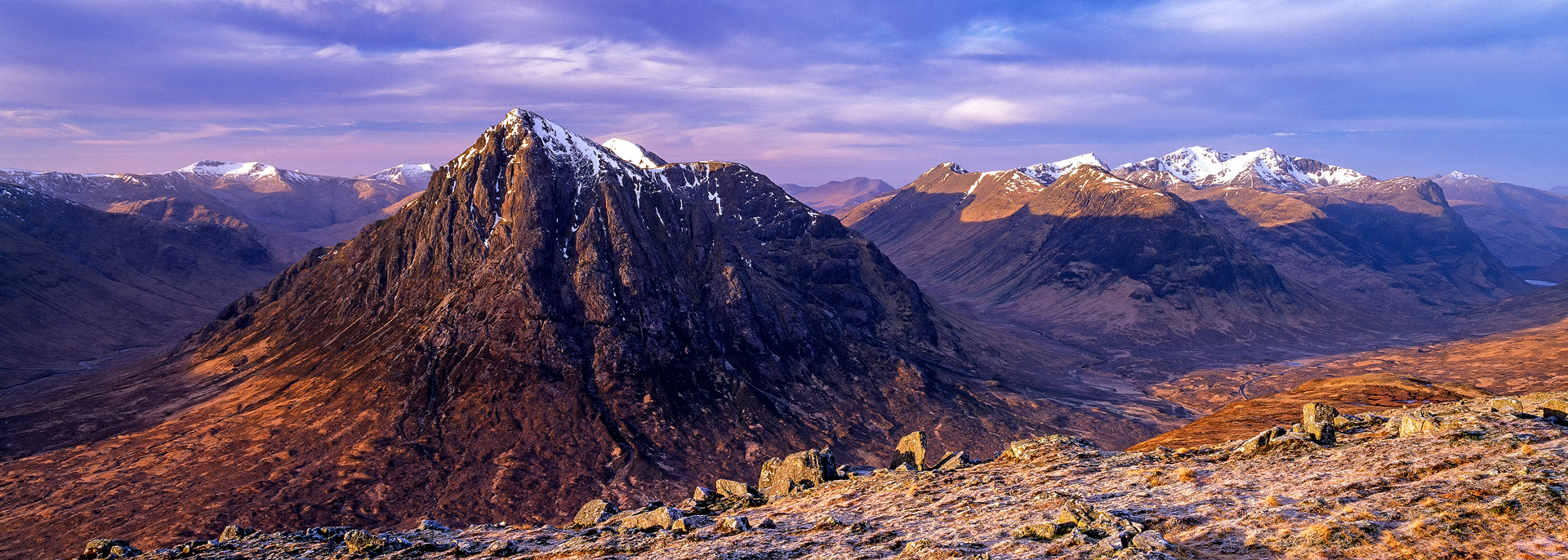
For fourteen years I photographed Scotland with the Hasselblad XPan, a panoramic film camera that captured the entire image in a single frame, with no stitching or joins. The image above was one of the first photographs I was pleased with, Buachaille Etive Mòr, from a viewpoint I’d previsualised and reconnoitred long before I ever carried a camera up there. Achieving it made me believe the whole approach might actually work: the planning, the patience and the chase.
Eventually, though, the balance began to shift. Film became harder to find, more expensive to buy, and every photograph meant another roll to process, another parcel to post, and another long wait before I could even see the result. It was a wonderful way to work, but an increasingly difficult one to justify.
When Hasselblad announced the XPan lens adapter for the X System, along with an XPan crop mode, it was the first time I seriously considered digital as a genuine replacement. Until then, I’d never believed there was one.
I bought my first X1D in December 2019. At first I simply tried to recreate the XPan. The same three lenses. The same fields of view. The same way of working. It took me a long time to realise I didn’t have to.
Once I stopped trying to recreate the XPan, everything opened up. Longer focal lengths let me photograph Scotland in ways I’d never been able to before. The limitations of the XPan’s three-lens system disappeared, and with them came photographs I simply couldn’t have made before. My photography didn’t change overnight, but it did evolve.
Looking back, I don’t think the camera mattered nearly as much as I once thought it did. The XPan taught me how I wanted to photograph Scotland; everything I’ve used since has simply become a different way of doing the same thing. The equipment has changed over the years, and no doubt it will continue to do so, but the reasons for going never have.
There are no shortcuts in mountain photography. Not in Scotland.

Along the way I’ve been fortunate enough to become the first winner of the Scottish Landscape Photographer of the Year in 2014, and to publish two books of Scottish panoramas, The Highlands: Land & Light (2012) and Wild Light (2018). They’re things I’m proud of, but they were never really the point. The point has always been the experience of the wild, the mountain, the weather, the light, and being there when it all finally comes together.
If one of these photographs reminds you of somewhere you love, somewhere you’ve been, or somewhere you hope to go one day, then it’s found the right home.
